
Proper priming helps ensure consistent reagent delivery and reliable synthesis results. If priming is set incorrectly, it can lead to:
-
Reduced coupling efficiency
-
Inconsistent results between columns
-
Unnecessary reagent consumption
-
Reagents running out earlier than expected
Understanding how priming works and how to set appropriate prime times can significantly improve synthesis reliability and reagent efficiency.
What Priming Does
Inside the synthesizer, reagents travel through a network of tubing and a fluidic manifold before reaching the synthesis columns. This system contains a small amount of dead volume, which is the internal volume that must be cleared before fresh reagent reaches the column.
Priming ensures that this volume is cleared before the reagent is delivered to the column.
If priming is insufficient, not enough reagent will reach the columns which can affect coupling efficiency.
Typical Prime Time Values
Prime time is configured in milliseconds (ms) and determines how long a reagent line is flushed to the first column before the Section step is executed.
Typical recommended values:
| Prime Time | Approximate Volume (ACN) |
|---|---|
| 350–500 ms | 50-150ul |
Actual delivered volume can vary depending on:
-
System pressure
-
Reagent viscosity
-
Bottle size
-
Tubing configuration
For most applications, a prime time between 350–500 ms provides a good balance between reliable reagent delivery and efficient reagent usage.
How many times priming is performed
Most synthesis reagents are delivered simultaneously to all active columns during a cycle. These steps generally require priming only once per cycle.
Examples include:
-
Deblocking
-
Washing (ACN)
-
Capping
-
Oxidation
Coupling steps are different because multiple amidites may be delivered through the same fluidic channel in the same section of the protocol. Because of this, the line must be primed for each repetition to ensure the correct amidite reaches the column.
For example:
If a protocol includes three coupling steps per cycle, the line will typically be primed three times per cycle.
For this reason, it is important that mid-synthesis priming is enabled in the system configuration.
Where to Enable Mid-Synthesis Priming
To ensure the system performs priming during synthesis cycles:
-
Open the Configuration Screen in the software.
-
Locate the Mid-Synthesis Priming setting.
Ensure that Mid-Synthesis Priming is enabled.
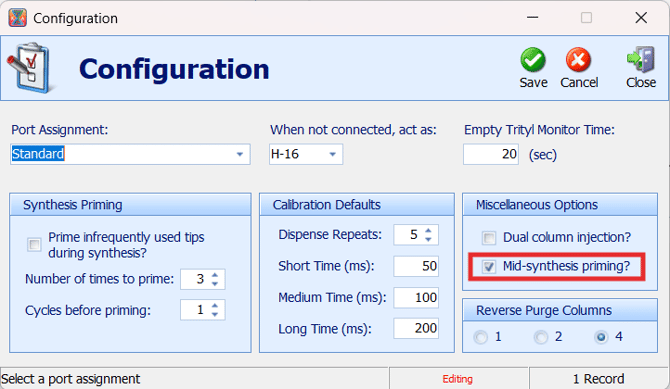
This setting allows the system to prime the reagent lines between synthesis steps as required.
Where to Adjust Prime Times
Prime times are configured in the Priming Screen of the software.
To adjust priming values:
-
Open the Priming Screen.
-
Locate the reagent lines you wish to adjust.
-
Set the desired prime time (ms) for each reagent.
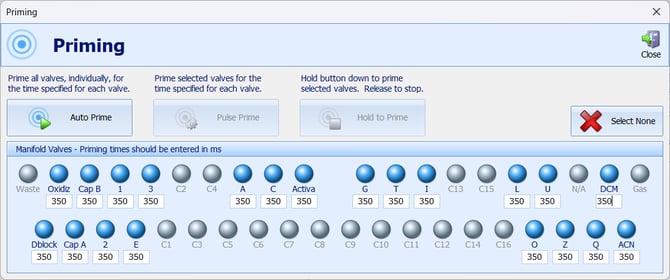
These values determine how long each reagent line is primed before delivery to the synthesis column.
Effects of Insufficient Priming
Reagents Located Further from the Column
When priming is set too low, the dead volume in the manifold may not be completely cleared before reagents are delivered.
Reagents that originate from positions further upstream in the fluidic manifold must travel through a larger internal volume before reaching the column. If the priming time is insufficient, these reagents may not fully displace the solvent or air present in the manifold.
As a result:
-
Reagents located closer to the column tend to perform more consistently
-
Reagents further upstream may show reduced coupling efficiency
-
This can appear as uneven performance between amidites or columns
These patterns are often visible in synthesis logs and overall coupling performance.
The First Column in an Active Group
When synthesizing multiple columns at the same time, the first column in the active group is the most sensitive to insufficient priming.
This occurs because the first column to receive reagents experiences the greatest influence from any residual dead volume remaining in the manifold.
Examples:
| Active Columns | Most Affected Column |
|---|---|
| 1,3,5,7 | Column 1 |
| 4,5,6,7,8 | Column 4 |
Symptoms may include:
-
Lower yield in the first column of the group
-
Increased variability in synthesis metrics
-
Less consistent histogram distributions
Monitoring the first column in a group can often help identify priming issues early.
Effects of Excessive Priming
While insufficient priming can cause synthesis inconsistencies, priming that is set too high can also create problems.
Excessive priming can lead to:
-
Higher reagent consumption
-
Reagents depleting faster than expected
-
Increased synthesis costs
- Diluted trityl values for the first column due to excess deblock
For longer sequences, unnecessarily long prime times can result in a significant amount of reagent being consumed during priming steps alone.
Recommended Prime Settings
For most systems, the following approach works well:
-
Start with 350–500 ms prime time.
-
Monitor synthesis results across columns.
-
If the first column in the active group shows reduced performance, slightly increase the prime time.
-
If reagent consumption appears unusually high, consider reducing the prime time while monitoring synthesis quality.
The goal is to set the prime time just long enough to clear the manifold dead volume without unnecessarily wasting reagent.
Summary
Priming ensures that reagents fully reach the synthesis column by clearing the dead volume inside the fluidic manifold.
If priming is too low, the manifold may not be fully cleared, which can affect coupling efficiency and create variability between columns.
If priming is too high, reagent consumption increases unnecessarily.
For most applications, 350–500 ms provides a good balance between reliable reagent delivery and efficient reagent usage.