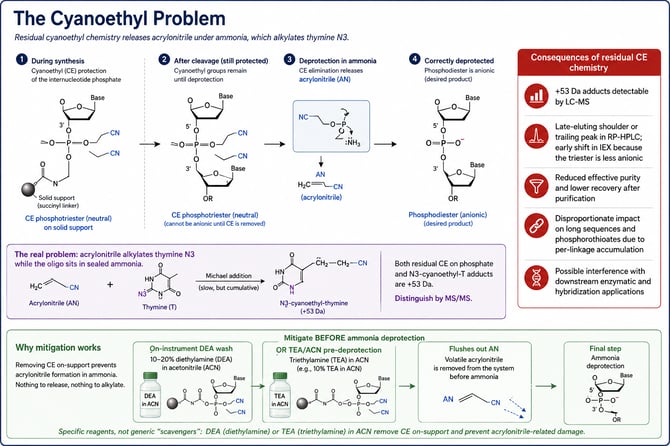
A known failure mode is formation of cyanoethyl adducts, e.g., reactions with nucleobase sites (commonly discussed for thymidine). This can create undesired modified full-length product and complicate QC/purification.
Common mitigation approaches
Two general strategies:
-
Add scavengers during C&D (e.g., thiol scavengers; specific options depend on protocol validation)
-
Remove cyanoethyl groups before cleavage
-
Example approach discussed internally: use a secondary amine (e.g., DEA) as a final step on the synthesizer to remove cyanoethyl groups quickly (minutes), then proceed with standard C&D.
-
Important: Specific reagents and timing should follow validated internal protocols and/or supplier recommendations for the chemistry/modifiers in use.