
The Flow Rates screen lets you calibrate and record the measured flow rate of each reagent and amidite line on your K&A instrument. KA_Labs uses these values to estimate reagent consumption, so keeping them current is what makes the Estimate Volume function accurate. Reviewing the values across all lines is also one of the quickest ways to spot a partially blocked line or a valve that needs service.
Applies to
- All K&A H-series instruments (H-2 through H-32) running KA_Labs software.
When to use this
Check and recalibrate flow rates in any of these situations:
- About once per month, as part of routine preventative maintenance (PM).
- When you suspect a discrepancy in a line's dispense volume.
- After any valve replacement or tubing change that could affect delivery.
- When Estimate Volume results look inaccurate.
Before you start
- The instrument is powered on, KA_Labs is running, and no synthesis is in progress.
- A clean, dry graduated cylinder or tared collection vial to measure dispensed volume.
- Reagent and amidite bottles are installed and the lines have been primed, so each line is full and free of air. Priming is on the Priming screen.
Open the Flow Rates screen
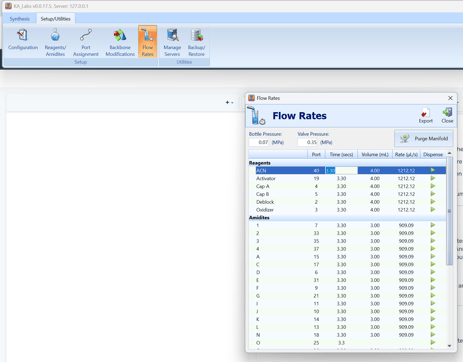
- In KA_Labs, select the Setup/Utilities tab.
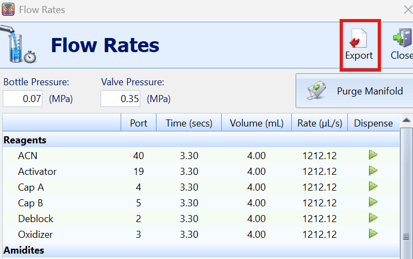
- Open the Flow Rates screen. The screen lists each reagent and amidite line with its current recorded flow rate.
Review flow rates as a diagnostic check
Before recalibrating, read the existing values. The pattern across lines tells you whether a line is healthy.
- Compare each line against the others. A line that reads noticeably lower than comparable lines is the first thing to investigate.
- Compare each line against its own history. A value that has drifted down from its previous calibration points to a developing problem on that line.
NOTE: A flow rate that is significantly lower than its peers or its own historical value can indicate a partially blocked line, a worn membrane, or a valve in need of service. Treat a large discrepancy as a prompt to inspect that line, not just to re-enter a number.
Calibrate a line
Calibration means dispensing a known volume from a line, measuring the actual output, and recording it so KA_Labs has an accurate flow rate for that line. Repeat the procedure for each line you need to calibrate.
NOTICE: Dispensing reagents and amidites involves solvents and reactive chemistries. Collect into an appropriate container, work in the instrument's normal ventilation, and follow your site's chemical handling procedures. Spilled or mishandled reagent can damage the instrument and waste costly amidite.
- Verify the Bottle Pressure and Valve Pressure.
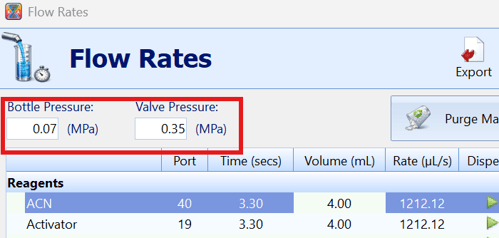
NOTE: A significant change in pressure could explain any change in flow rates. Verify that these are consistent with prior settings and are within the recommended ranges.
- On the Flow Rates screen, select the line you want to calibrate.
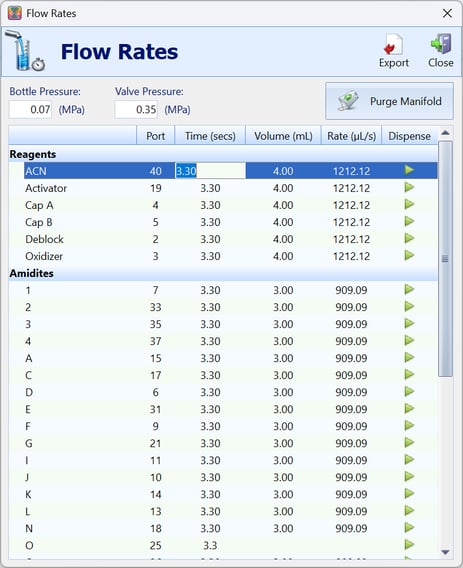
- By default the waste will go through the waste line. Be sure the waste line is set to dispense into a waste container or vial.
- Prime the line with the reagent you are wanting to fully fill the waste line. You can then discard the waste if
- Position a graduated cylinder or tared vial to collect the output from the fully primed waste line.
- Confirm the dispense duration. The default reagent dispense time is 3.3 seconds. Leave this at the default unless you have a specific reason to change it, because the value affects the measured result and downstream volume estimates.
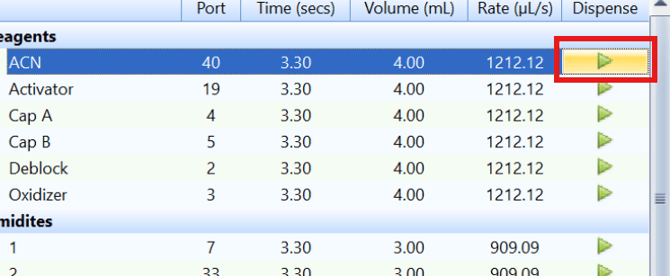
- Dispense the line for the set duration using the screen's dispense control. [
- Measure the volume actually collected.
- Enter the measured volume into the line's entry field on the Flow Rates screen. KA_Labs uses the measured volume and the dispense duration to calculate and store the flow rate for that line.

- Repeat for each remaining line.
- The Flow rates can be exported for future reference.
NOTICE: Flow rate values must be entered and current for Estimate Volume to produce accurate results. If a line has never been calibrated, its volume estimates will be unreliable.
Verify the calibration
- The recorded flow rate for each calibrated line updates to a value consistent with comparable lines and with that line's history.
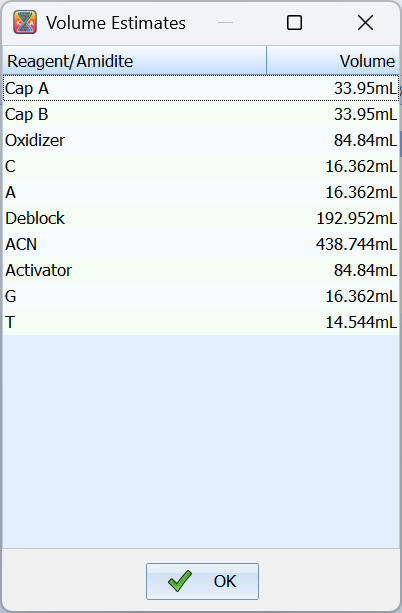
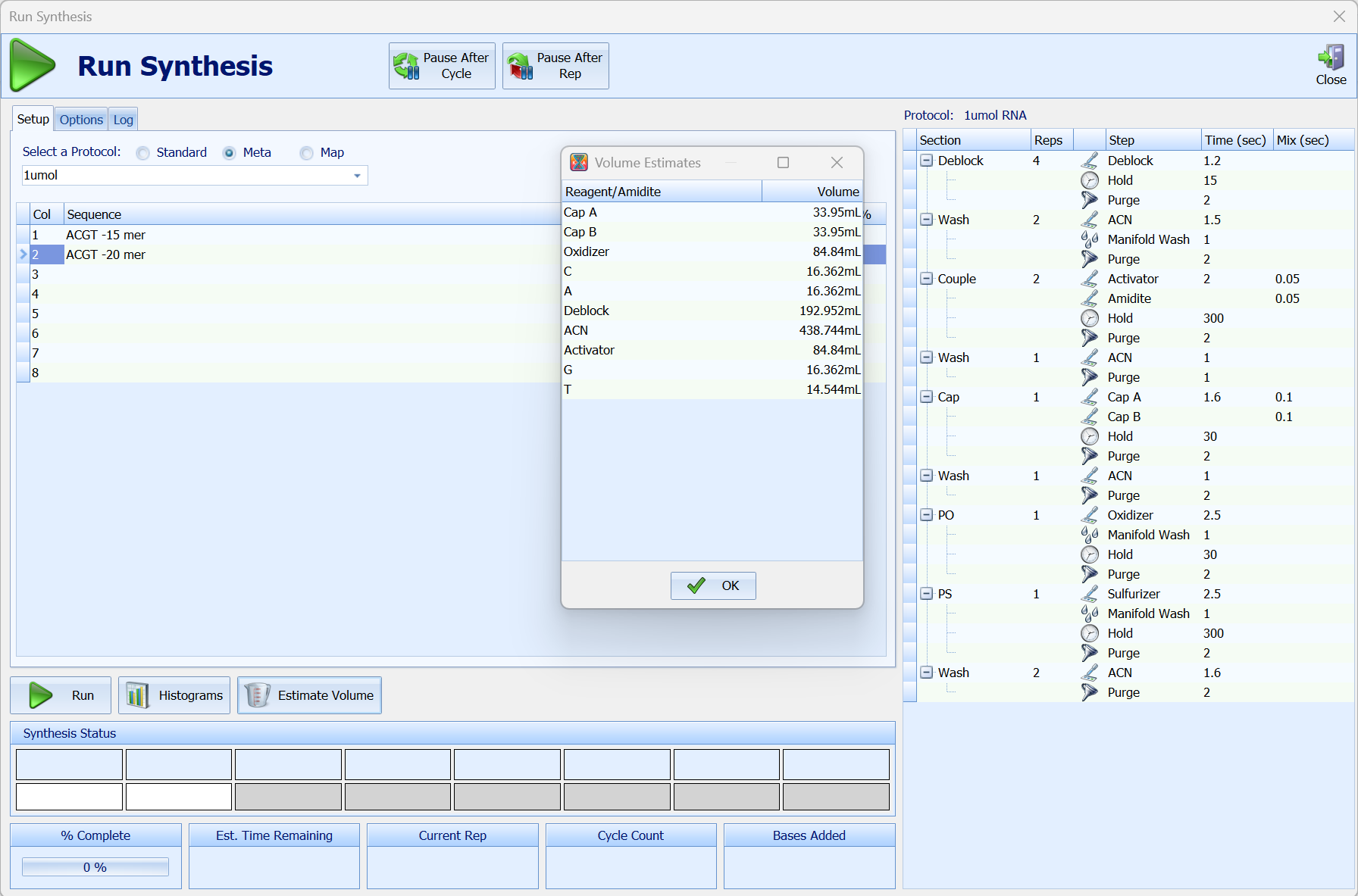
- Run Estimate Volume for a representative synthesis. The estimated reagent consumption should look reasonable for the run. If a single line's estimate is still off, recheck that line's measured volume entry.
Troubleshooting
| Symptom | Likely cause | Resolution |
| One line's flow rate reads much lower than the others | Partially blocked line, worn membrane, or a valve needing service | Prime the line and redispense. If the low reading persists, inspect the line, membrane, and valve, and service as needed before recalibrating. |
| A line's flow rate has drifted down from its previous calibration | Gradual restriction or wear developing on that line | Inspect the line and valve for that channel. Recalibrate after any service or tubing change. |
| Estimate Volume results look inaccurate | Flow rates not calibrated or out of date | Recalibrate the affected lines, then rerun Estimate Volume. |
| Little or no volume collected when dispensing | Air in the line, empty bottle, or a closed/failed valve | Confirm the bottle is full, prime the line on the Priming screen, then redispense. If still dry, service the valve. |
For help, contact support@sierrabio.com.
Last reviewed: 2026-06-25. Owner: Field Operations. Applies to: K&A H-series running KA_Labs software.